
TERMINOLOGY
Free resources are farther down the page.
Some of those resources are videos that put these words into context, which will make it easier to learn them.
BODY DOUBLING:
This is a term for co-working, or even ‘parallel play’. It’s when two or more people work nearby each other without interacting (or with minimal interaction) as way to stay focused on the task at hand.
Body doubling has been a game changer for me, especially for the tasks my brain has high friction or resistance to.
I just call up a friend on the phone, I don’t even need to be in-person with them, and my brain’s resistance to starting and continuing a task reduces significantly.
BRAIN FOG :
This is a term for slow brain processing often used by people experiencing overwhelm, sleep-deprivation, or any low-energy state of the body such as illness.
The Cleveland Clinic defines it as a term: “…for a range of symptoms that cause cognitive impairment. This affects your ability to think clearly, focus, concentrate, remember and pay attention.” ( https://my.clevelandclinic.org/health/symptoms/brain-fog)
COGNITIVE LOAD THEORY:
COGNITIVE = related to learning or knowledge. LOAD = something that is carried. This refers to knowledge that our brains have to hold on to.
This means that during our day the amount of knowledge chunks and things to remember to act on are using up EFFORT because we have to carry them mentally.
See “working memory” to see how neurodivergent brains like ours carry way more cognitive load during each task than neurotypical “normies”.
EISENHOWER MATRIX
This is a chart with urgency on one axis and importance on the other. This is very effective for many N.T. people, but it often causes choice paralysis for N.D.s.
It doesn't always help deciding true importance for N.D.s, it only works if you commit to or OUTSOURCE decision making based on the chart to focus down instead of getting stuck in decision paralysis because your brain thinks multiple things take priority at once.
I often use these charts when I have a buddy around to help me make a final choice.
EXECUTIVE DYSFUNCTION
This is a group of mental abilities that allow us to function, including time management, attention control, working memory, inhibition, motivational regulation, emotional regulation, planning, and problem-solving.
When I say my brain isn’t “cooperating”, I’m referring to executive dysfunction.
According to The Cleveland Clinic: “Because executive functions involve so many processes inside of your brain, executive dysfunction can take many forms. Some examples of executive dysfunction include:
Being very distractible or having trouble focusing on just one thing.
Focusing too much on just one thing.
Daydreaming or “spacing out” when you should be paying attention (such as during a conversation, meeting, class, etc.).
Trouble planning or carrying out a task because you can’t visualize the finished product or goal.
Difficulty motivating yourself to start a task that seems difficult or uninteresting.
Struggling to move from one task to another.
Getting distracted or interrupted partway through a task, causing you to misplace items or lose your train of thought (like leaving your keys in the refrigerator because you wanted a snack, but your hands were full, so you put your keys down inside the refrigerator and forgot about them).
Problems with impulse control, like snacking when you’re trying to manage your diet.
Struggling with thinking before you talk, causing you to blurt out the first thing that pops in your head without considering that it might hurt someone’s feelings.
Having trouble explaining your thought process clearly because you understand it in your head, but putting it into words for others feels overwhelming.”
(https://my.clevelandclinic.org/health/symptoms/23224-executive-dysfunction)
This includes the VERY IMPORTANT ability to decide what to do and then to START doing it.
Struggling with this is NOT LAZINESS.
This is the same area of the brain that overrides your choice to touch a hot flame regardless of your determination.
N.D. brains are often driven by interest and urgency, so a common pattern for N.D.s is learned very young: if I wait until last minute I'll get scared enough that my body will produce adrenaline for me, and that adrenaline will OVERRIDE executive dysfunction, allowing me to complete the task.
This is great for emergencies, but when we learn to rely on it as our only way to function, it results in plenty of bad health outcomes and will become less and less reliable the longer we "push through", eventually leading to burnout and energy collapse.
A handy METAPHOR for executive dysfunction: trying to get yourself to put on a necklace when it's tangled with a bunch of others, and your hands are slippery, and you don't really even like the necklace you're trying to put on
MASKING
The ability or practice of hiding overtly neurodivergent tendencies for the purpose of seeming neurotypical or to avoid negative reactions from neurotypical society.
Examples:
making the “normal” amount of direct eye contact during conversations despite discomfort or difficulty
forcing facial expressions (such as smiling when we don’t feel like it), often to communicate friendliness or to avoid being perceived as upset or “having an attitude”, regardless of actual mood or intended communicated expression
mirroring or studying people’s body language, tone, dialect, and/or expressions when unsure of the “normal” way to behave with a neurotypical person, more common when we are in unfamiliar environments or with new people
laughing at jokes we don’t find funny if the people we are with are laughing, on order to not stand out or seem “slow”
asking follow-up questions about a person’s shared story instead of sharing a similar story of our own to show connection
eating foods in a random order instead of organizing them by color or size if our brain prefers that
forcing “normal” body postures, stillness, or other mannerisms in the company of other people, especially when experiencing a strong emotion (hand-flapping, tapping your feet, tapping out a rhythm on objects nearby, jumping up or down, “being fidgety”, or other “unusual" movements)
meeting social expectations for clothing despite disliking the texture or fit of the clothes
having “scripts” or practiced phrases ready to use in conversation, especially situation-specific or person-specific responses
avoiding sharing our true interests or preferences for fear of others finding them “unusual”
avoiding singing, repeating fun words, speaking to ourselves, or “scripting” dialogue from a piece of media when in the company of others, when we would naturally do so in private
avoiding touching items around you in public that have interesting-looking textures (for me it is most often walls and plants), despite the urge to do so
having to use a significant amount of effort to not interrupt someone while they are speaking when we have something relevant to share about their topic
choosing to hide our stress or upset when plans get changed day-of because people in the past have told us we are “too uptight” or “can’t go with the flow”
forcing ourselves to stay in sensory-overwhelming environments such as concerts, crowded bars, etc. in order to spend time with people who like those areas
carefully monitoring our volume when speaking, because people have often told us we are “too quiet” or “too loud”
avoiding hobbies or activities that might draw too much attention or get us labeled as “weird” because we have already been labeled as “odd” or “weird” so often in life from just existing
Masking is a HUGE ENERGY DRAIN. It is often necessary to communicate effectively with neurotypicals, especially in work environments, but the more we can practice un-masking in daily life, the more brainpower we will have for the things we want to do.
NEURODIVERGENT / NEUROTYPICAL
Neurodivergent (N.D.) = a term for brain function that differs from “typical” functioning. Often used in reference to autism, ADHD, OCD, and other diagnoses. Most of the terms I include on this page are common challenges for N.D. brains.
Neurotypical (N.T.) = a term for “typical” brains that fit the majority norm in society, also called “allistic” when contrasted with an autistic brain. Neurotypicals (N.T.s) CAN AND DO DEAL WITH some of the same issues as N.D.s when stressed, depressed, sleep-deprived, or ill, but it is not their everyday normal like it is for us.
According to the Cleveland Clinic:
“Neurodivergent isn’t a medical term. Instead, it’s a way to describe people using words other than “normal” and “abnormal.” That’s important because there’s no single definition of “normal” for how the human brain works.” (https://my.clevelandclinic.org/health/symptoms/23154-neurodivergent)
WHAT IF I DON’T HAVE AN OFFICIAL DIAGNOSIS OR DON’T WANT TO GET ONE?
You DO NOT NEED a formal diagnosis for either autism, ADHD, or OCD to work with me! As long as you see yourself suffering from some of the challenges I list on this page such as time management difficulty, executive dysfunction etc., then my services will likely benefit you.
If you’d like to take a science-backed RAADS-R 80-item questionnaire developed to help people self-identify likelihood of autism, there is a free one here:
Here is a foundational research overview of the above questionnaire (you can see how reliable it is, and the flaws it has with some wording and question choice):
https://embrace-autism.com/raads-r-foundational-research-overview/
There is also a different style of free autism questionnaire that looks at 7 different traits instead of giving you an overall score:
https://embrace-autism.com/autistic-traits-profile-questionnaire/
There is a free VERY QUICK 6-item questionnaire for identifying ADHD here: https://adhdquiz.com.au/asrs/
Here is a quick 18-item questionnaire for identifying OCD: https://psychology-tools.com/test/obsessive-compulsive-inventory-revised
Here is a free, very UNSCIENTIFIC, for-funsies Adult Masked Autistic Quiz someone created because they felt the official questionnaire above was targeting at people with less masking habits:
SPOONS THEORY
This is similar to cognitive load theory but with the specific focus on a limit to your daily load, meaning if you use up all your energy "spoons" for the day you will start pulling from adrenaline or from tomorrow's energy, which will start to hit your health in multiple ways really fast.
Some tasks take up half a spoon, some take up multiple spoons.
The definition of what counts as a ‘spoon’ will be personal to your brain and body, but it is often a big emotional reckoning to realize how few spoons we actually have available each day if we want to stop damaging our health and reverse brain fog and burnout.
TASK PARALYSIS / DECISION FATIGUE
This is technically part of executive dysfunction but I like to give it separate focus.
This is when you cannot effectively decide what task takes highest priority, and enter a "buffer" state mentally where you can't get any one task started.
a handy METAPHOR: a multi-color pen, each color is a thought trying to start an action, but our brain tries to click all colors at once and there's a “traffic jam” where no color is able to get fully clicked out and become usable
TIME BLINDNESS
Our brains often see events as happening “now” or "not now". This is also called Event-based Time as opposed to Clock Time .
Trying to remember Clock Time with N.D. brains often results in us always being in a rush or worried about being late.
Even if we schedule buffer time to make sure we arrive early, the effort we are putting in is more than a N.T. would need.
Trying to remember start times for more than two events for our day adds cognitive load and often results in forgetting or switching to adrenaline to survive.
UNTIL we give the event a place in Clock Time by scheduling it EXTERNALLY on a calendar or similar tool, it will be floating around only existing if it is up next in your schedule for the day.
Outsourcing that clock management to a reliable calendar and alarm combination (instead of forcing our brain to keep track of it constantly) will reduce cognitive load.
TRANSITION FRICTION
This is resistance to transitioning between tasks, and loss of momentum + focus when transitioning from one task to another.
This has been a long lesson for me to learn personally, but it has made a huge difference.
Lowering the transition friction between events and tasks saves me lots of energy and frustration.
EXAMPLES: setting out your outfit for the next event ahead of time, ensuring food and supplies are ready to grab-and-go, having a separate desktop space open on your computer where everything needed for a task is waiting and ready to start, etc.
POSITIVE REINFORCEMENT
Praising or rewarding a behavior in a way that encourages repeating that behavior.
The opposite of shame and blame.
For us N.D.s I’ve seen that we very often internalize the expectations of general N.T. society and expect ourselves to perform to the standard N.T.s can.
When we inevitably over-do it or take on too much, ignoring our own body and brain needs, there’s the tendency to shame ourselves for not living up to expectations.
Some of us were modeled this shaming in childhood or even adulthood.
When I can't perform up to expectations, the solution is to TEMPORARILY lower expectations, and to praise or reward the good things I have accomplished no matter how small, including just the effort to continue trying.
WORKING MEMORY
According to the Cleveland Clinic, working memory is a functional term to describe how we use short-term memory:
“Because you can organize, process and use information from short-term memory, researchers coined the terms “working memory” or “short-term working memory” and use them interchangeably.” (https://my.clevelandclinic.org/health/articles/memory)
According to Add.org:
“Executive dysfunction can affect working memory, making it harder to retain information while completing tasks. This may cause the individual to forget instructions, lose track of conversations, or misplace important items.” (https://add.org/executive-function-disorder/)
This also means that effectively EVERY task requires more effort, more brain power, and is is a multi-step task for us.
This DOES NOT MEAN that we are not smart and capable. It means we have to work harder and spend more energy to do what others can do.
Neurotypical (“normie”) brains can group a complex task into one single chunk for memory and make it actionable, neurodivergent (autistic/ADHD/etc.) brains often cannot, so the task of "get ready for an appointment" ends up taking up 20 chunks in your brain's task-analysis bandwidth instead of just one.
An example in your professional life could be “respond to email” turning into “open email inbox + look at newest emails + ACTIVELY DECIDE not to open each new email you see until you find the correct one + click on correct email + ignore message alert from your phone + read email + open calendar app to schedule appointment the email mentioned + return to email app + click respond …. etc.”
Do you see how many steps that is??
On a low bandwidth day that is way more energy required by our brains to handle a simple task.
ZEIGERNICK EFFECT
This refers to when unfinished tasks require working memory use in the brain, effectively taking up space in the brain's cognitive load as an "open loop" or "open tab" (if you like website metaphors).
These ‘open tabs’ can slow down our processing ability and memory recall similar to a computer, so we close the loop by putting them somewhere EXTERNAL like a notebook/app/calendar.
Memory use also takes up cognitive load!


https://www.theadhdtools.com/howtoprioritize
A video with excellent breakdown of how ADHD minds (and sometimes autistic as well) struggle with task prioritization, and how to get around that.
(15 minutes)
https://www.youtube.com/watch?v=BtREVQcka4o
A video that goes over the top mistakes ADHD business owners specifically make in terms of productivity and decision-making.
(16 minutes)
https://www.youtube.com/watch?v=ewicO7-wvqI
A video by a psychiatrist and N.D. specialist discussing externalization, planning for low-spoon days, and shame reduction.
(11 minutes)
https://www.youtube.com/watch?v=8LnWcAwhiS0
A video overview of executive dysfunction.
(37 minutes)
https://drive.google.com/file/d/1_UsUP91p5YuPLOfkx5qvxvOtFSk_Bzaf/view
“Why everything feels so hard” a self-audit worksheet by Asha Coaching, licensed psychologist
https://www.youtube.com/watch?v=rJ7kOSwU7AQ
THE MOST helpful video for me personally. It goes over basic views of time and momentum management for your day-to-day, the most impactful stuff to implement right now.
(18 minutes)
Free Resources

https://www.reddit.com/r/autism/comments/1qhcqjw/if_youre_autistic_neurodivergent_are_there_any/
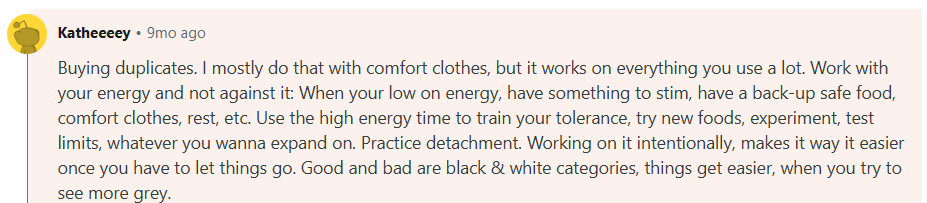
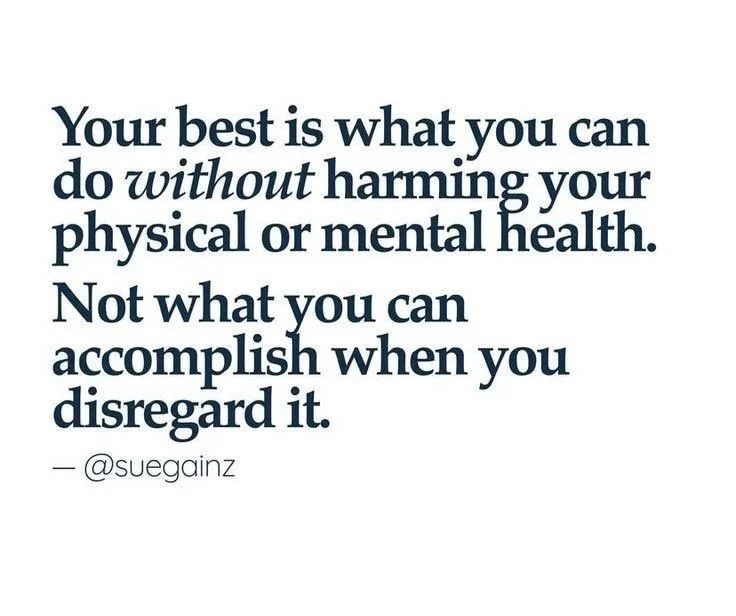
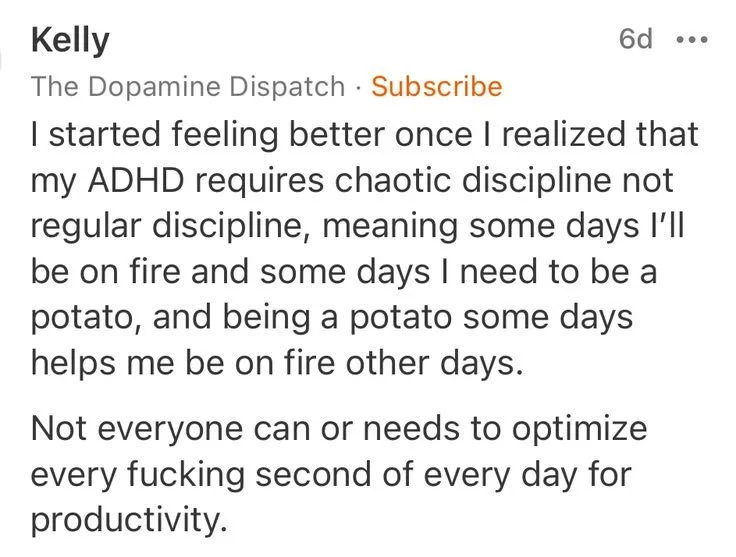
A Reddit thread with very personal, practical tips that more than anything are helpful for a sense of BELONGING and acceptance. You are not alone. There is hope of a far better future than you can currently imagine.
(long, 202 comments)
https://www.youtube.com/watch?v=BtREVQcka4o
A video covering sensory processing and sensory overload pretty well, especially with the explanation of INTEROCEPTION (awareness of internal body cues such as needing to pee or being hungry).
(8 minutes)
https://www.youtube.com/watch?v=F0QX2uHoq6A
A video covering the impact of improving sensory regulation on improving EMOTIONAL regulation. Essentially, learning to become aware of your sensory needs, and then care for them, reduces emotional overwhelm in the moment and over time.
(16 minutes)
https://troop.neuroscouts.org/index.html
An incredible website that offers physical card decks, field guides, and tons of cool resources for N.D.s.
https://troop.neuroscouts.org/therapy.html
Free and affordable therapy options in a searchable system set up by Neuroscouts. Therapy helped me a ton in recovering from burnout, as well as coming to a place of acceptance about my neurodivergence.
Visual Countdown Timer for Time Blindness:
Browser: https://visualtimer.com/
Phone App: https://play.google.com/store/apps/details?id=com.applorium.visualtimer&hl=en_US
(This needs to be always visible or it doesn’t work for our brains!!! You cannot have it open on a separate tab, it has to be front and center.)
Schedule your free call with me!
This is a free resource! During our 30 minutes I will go over how I can help you, but also do a quick audit of your current systems and see what the quickest high-impact changes could be.